

We had a large double fridge-freezer, and a walk-in pantry at our house. Now, we have to pack all of our food into the cupboards of a campervan.
The campervan fridge is a 240 liter fridge – the largest I’m told that is available for a campervan. I’m surprized, but it’s actually not too bad. It means that some of those things that we liked to keep in the fridge rather than needed to can’t go in.
We also have a 60 litre Waeco car fridge. Well, we did have a car fridge. That’s currently dead. The car fridge is trying to tell us that the room temperature is 60 degrees celcius (ah, about 200 fahrenheit?). Meanwhile, everything inside was frozen solid. Useless. Shame, because we liked using that as a freezer when we stocked up on meats or frozen vegetables.
Cupboard space? Well, it’s actually not as bad as I’d anticipated. When we were at the snow for winter last year we did a monthly shop in the nearest big town (Bairnsdale – 3 hours away). The cupboards were packed solid at the beginning of the month, but it did actually all manage to fit. Just.
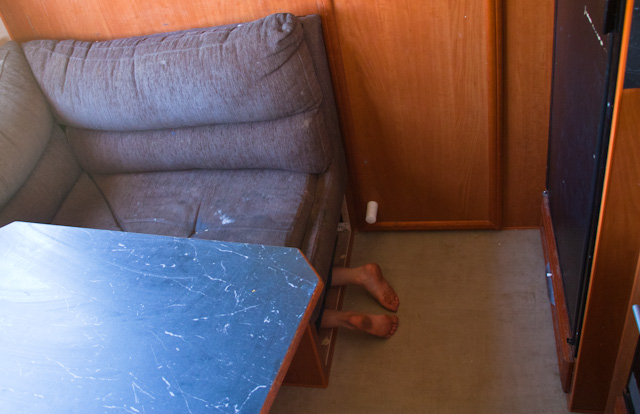
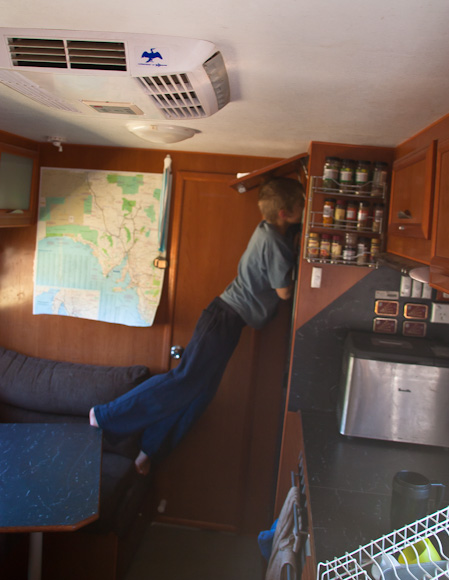
As long as you don’t count that most of our tinned food is underneath the couch. Being down low means that it’s better for balancing the weight of the campervan. One way to reach the tins is to pull the couch apart. Actually, if we want to reach what’s under the middle part of the couch, it’s the only way. That’s why we avoid putting anything we want often there. The easier way to get to the two sides of the space underneath the couch is to remove a drawer, then send the kid under the couch. Peter and Susan, who are ten and nine years old, complain bitterly that they are far too big to be sent under the couch. Poor Lucy usually ends up doing it. All you can see of her is a pair of feet waving around as she searches with the torch for the tin that we’re after.
The costs of food in rural areas was a real concern before we left. To be honest, it still is. I saw bananas in remote South Australia for $19 a kilogram one day. The only other fruit on offer there were apples and oranges. Great variety, huh? When I complained about it on Facebook, a friend in Alice Springs said they were the same price there. Apparently they were $11 that day in Brisbane, Queensland, yet only $6 a kilogram in Hobart, Tasmania. Makes no sense to me. Just costs a lot of dollars.
Is there anything we can do about it? Not really. We do our big shops in big towns, and then get bits and pieces in the small towns until we’re ready to move on. We’ll usually get at least some fresh fruit or something that we’ve run out of if the town has free camping that we’ve used. It’s our way of saying thanks. Getting local produce is good, but it’s not available everywhere. That was fine in areas where they grow lots of fruit. We loved it. In the desert, there aren’t exactly a lot of options for that.
(Though we found that the cellar door wine sales ended up being cheaper than what they would be in a shop, but they bottles were generally a higher price than we’d normally be able to go for and afford to travel.)
The big one is how to afford gluten-free, dairy-free travel. Usually the dairy free is no big deal. In a lot of places, rice milk is a fairly standard sort of price and it always seems to be around the $2 a liter mark. Soy milk is also fairly steady, and the only time we use it is for my coffee. We’ve found that making our rice milk is much, much cheaper. However, it only lasts about six days. We also find that we often look at each other at dinner time and say, “Oops, forgot to make it again today”. This is a big problem since it takes three hours to cook, and then another half hour or so to muck around with afterwards to bottle it. (Recipe here if you want)
To start with, we replaced bread with rice cakes. We just couldn’t find gluten free bread in most places, and when we could, it was disgusting. These tiny, hard loaves that generally crumbled when cut. Usually about $8 for a 500 gram loaf. Problem was, the kids were going through more and more of the rice cakes each day. They just weren’t filling enough.
On a visit to the grandparents back in Melbourne, my mother-in-law and I tried making a loaf of gluten-free bread by hand. Even though she said that I had to beat it quickly and well for at least 10 minutes, I think I lasted about one minute before I put the bowl down in disgust. We used the electric blender to do it instead. The rest wasn’t so bad to let it rise and bake (at least, she told me that bit was fairly easy. I had to go and do something really important while she finished baking that loaf).
So, having ruled out hand-making and buying gluten-free bread, we bought a Breville BBM600 bread maker. We find that the first two hours of the cycle it uses very little power. The third hour where it is baking tends to use a fair bit more. I ran it three days in a row of the campervan batteries and solar panels alone when we first got it. The batteries were completely drained. Jarrad now tells me I can only use it when the generator is running, or while we are driving so it runs off the Anderson plug from the car. (Recipe here). It is fantastic to have a loaf of bread baking while we drive, so when we pull up there is a hot loaf of bread ready to eat (and the smell of baking bread, too).

A really big difference is how often we eat and cook outside. Everyone has a really strong preference for eating casseroles and roasts cooked in the dutch oven on a campfire. Of course, the kids also like roasting marshmellows on the campfires, too.

I find that the food isn’t that much different to what it was at home. We do have a lot more casseroles in the dutch oven on the campfire. There are times that we rely more on the tinned veggies than the fresh veggies, or fresh fruit has to be rationed as we’re in an area that it’s just too expensive. It’s annoying not being able to stock up on meat and frozen veggies because we don’t have the freezer space, or something else because it’s on special. In the end, we don’t really seem to notice it too much most of the time now.
Oh, the biggest problem is getting to the shops. Shops are only open in most rural and remote areas between 9 and 5, Monday to Friday. Maybe Saturday morning if you’re lucky. Some areas are even shut for an hour for lunch in the middle of the day. There’s no more going, “oops, forgot to get that. Damn, it’s already 11 o’clock. Better dash down to Woolworths before they close at midnight.” We’ve got to think ahead a little further than that.


Latest posts by Amy and Jarrad (see all)
- While in Sydney - January 24, 2013
- Festivals Around the World - January 23, 2013
- Off to Sydney - January 18, 2013
 About Amy and Jarrad


I’m impressed with what you are able to accomplish with cooking, baking and shopping on the road, including food restrictions and prices. I love that you make the bread while you’re driving. That is something to look forward to when you arrive.
Twitter: livinontheroad
says:
Thank you Lisa! Having the bread baking while we’re driving is fantastic! We love having it ready when we arrive!
Twitter: fearnowrath
says:
A car fridge is really really handy. I have felt the need of it so often. The only thing that I hated about my old SUV was the lack of fridge(but hey it was a 20 year old model).
I would be happy with a small sized fridge in a car. The 60 litre Waeco car fridge is just WOW.